
Schemes like the Mukhyamantri Majhi Ladki Bahin Yojana strain fiscal resources amid rising unemployment and prices of food items.

Ahead of the upcoming budget, eminent economists during a meeting with Prime Minister Narendra Modi on Thursday urged the government to take steps to accelerate economic growth and improve infrastructure, sources said. The meeting was organised by the NITI Aayog on Thursday to elicit views and suggestions of economists for the first budget of the Modi 3.0 government. "Earlier today, interacted with eminent economists and heard their insightful views on issues pertaining to furthering growth," Modi said in a post on X.

Few finance ministers announce any taxation measure that could upset the stock market. Ms Sitharaman decided to take that risk, observes A K Bhattacharya.

Cargill believes the reforms would act as a catalyst in attracting private sector investment in building supply chains for taking Indian farm produce to national and global markets.

Analysts believe the GST could boost India's economic growth by up to 2 percentage points

"Of the structural reforms, the GST has been the most historic in our country. Its chief architect is not with us today. I pay homage to the visionary leader late Arun Jaitely. GST has been gradually maturing into a tax that has integrated the country economically," she said during her budget speech.

His about-turn in the farm laws proves that he sees everything in just one dimension: Politics. That helps sometimes. But not always, observes T C A Srinivasa-Raghavan.

As the voting process for the new Conservative Party leader formally opened with postal ballots being mailed out to Tory members from Monday, Rishi Sunak vowed to cut the basic rate of income tax by 20 per cent in a few years if he is elected Britain's prime minister.

Construction costs would be reduced to some extent and this benefit can be passed on to the customers, thereby spurring home buying

'We are confident that over the next few years the government will strike a fine balance between populist measures and growth, and manage coalition partners well.'

There is nothing to be worried about as bilateral ties are robust with solid foundations. Both are on the same page on the economic and defence/security ties bilaterally and globally and that shall continue irrespective of change in political dispensation in either country, points out Dr Rajaram Panda.

DTC task force also favoured doing away with Dividend Distribution Tax by suggesting taxing dividends in the hands of shareholders.

The implementation of the GST will indeed be a landmark reform.

Eminent economist Arvind Panagariya has said India is on the cusp of returning to a high growth trajectory and voiced confidence that the country will become the world's third-largest economy by 2027-28. Currently, India is the fifth largest economy "so it's another five years.We are already in (the year) 2023. "So 2027-28, India should be the third-largest economy," Panagariya, Columbia University Professor and former Vice Chairman of NITI Aayog, told PTI in an interview in New York.

Finance Minister Nirmala Sitharaman on Wednesday raised the personal income tax rebate limit, doled out sops on small savings and announced one of the biggest hikes in capital spending in the past decade as she did a tight rope walk in the Budget between staying fiscally prudent and meeting public expectations in the year before general elections.

Finance minister Nirmala Sitharaman on Monday said windfall tax on petroleum products, crude is not ad hoc, but being charged in regular consultation with the industry. Addressing an event organized online, the minister said it is unfair to call windfall tax as ad hoc, because the tax rate and its resetting are done in complete consultations with the industry. "The very idea was implemented after taking the industry into full confidence," she said at a function organised by Elara Capital.
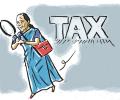
While the ratio determines the extent to which the government is able to finance its expenditure, it is also an indicator of tax compliance. Developed countries have a higher contribution of tax to their GDP.
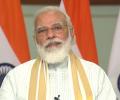
"The emphasis is on making every rule, law, policy people-centric, and public-friendly. This is the use of the new governance model and the country is getting its results," Prime Minister Modi said while speaking at the launch of a platform for 'Transparent Taxation -- Honoring the Honest'.
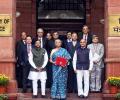
Finance Minister Nirmala Sitharaman on Thursday presented her sixth Budget in a row, equalling the record of former Prime Minister Morarji Desai.

The remarkable feature of those reforms unveiled in 1991 is that none of those decisions has been disowned by subsequent governments in the last 25 years.

Finance Minister Nirmala Sitharaman will have to do a tight-rope walk between staying fiscally prudent and general public expectations of lower taxes and a wider social security net, while at the same time firing the engines of the economy before general elections. Sitharaman will on Wednesday present her fifth straight Budget at a time when the economy is slowing due to global headwinds and specific sectors need attention. In the run-up to the Budget presentation, expectations are rife that she may tweak income-tax slabs to provide relief to the middle class and increase spending on the poor through programmes such as the rural job scheme while ramping up financial incentives for local manufacturing.

Thrust on infrastructure and capital expenditure is expected to continue in the Union Budget for FY25.

'If there is a push towards a Marxist oriented government it will be dangerous.' 'We have seen this in Nepal and Myanmar and it will be a concern for India if it is surrounded by countries with such political dispensations.'

As far as possible, investment in the agriculture sector must be from the government, and not the private sector, states Santushti Raj Thapar.

Announcing his tax reforms Trump said his policies would benefit working families.

The challenge is to convince productive sectors that a lower general rate would benefit all and remove the prevalent system of favours targeted towards narrow industry and service sector groups.

A government that confuses PowerPoints for policy is delaying structural change too much.
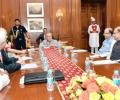
Government will lay greater emphasis on social sectors, finance minister said.

Finance Minister Nirmala Sitharaman on Thursday announced a Rs 11.11 lakh crore spending on infrastructure and vowed to continue reforms as she resisted resorting to populist measures in Modi government's last Budget before general elections, instead choosing to stay on the path of cutting deficit while bolstering measures for focus groups.

The Sensex posted its biggest single-day jump in over a decade at 1,921 points and investors' wealth soared by a staggering Rs 6.8 lakh crore after Finance Minister Nirmala Sitharaman delivered a surprise cut in corporate tax rates on Friday.
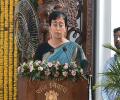
Atishi will have a brief tenure in office as assembly elections in the national capital are due in February.

'Sin tax' is a globally prevalent practice under which products like alcohol and tobacco attract higher rates of tax.
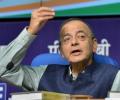
Years before the Supreme Court struck down as 'unconstitutional' an opaque political funding tool that allowed individuals and companies to donate money to political parties anonymously and without any limits, the then finance minister Arun Jaitley -- the prime mover of electoral bonds -- had termed them legitimate and transparent.

Nirmala Sitharaman on Wednesday assumed charge as the Finance and Corporate Affairs Minister for the second consecutive term and is slated to soon present the final Budget for FY '25 that is going to set the tone for the Modi 3.0 government's priorities and direction for Viksit Bharat. Upon her reaching the North Block office, Sitharaman was greeted by Finance Secretary T V Somanathan and other top officials. Minister of State for Finance Pankaj Chaudhary was also present. Chaudhary assumed charge on Tuesday evening.
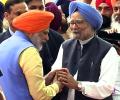
Whether it was the MGNREGS or the NFSA or the Aadhaar-based DBT scheme for cash transfer, the Modi government has built on the basic architecture created by the Singh government. Policy makers in the Modi government, instead of discarding them as products of the previous political regime, worked on them, expanded their scope and reach, and used new tools to improve their performance, explains A K Bhattacharya.

The generation of quality jobs and skill development should be the focal point, cutting across ministries and departments, asserts Nivedita Mookerji.

A staggering $18 trillion worth unaccounted money is stashed in tax havens.


The future of Rishi Sunak as Britain's Prime Minister and leader of the Conservative Party hangs in the balance as polling booths opened across the United Kingdom on Thursday, with millions expected to turn out to cast their votes in the general election.

GST seeks to subsume many indirect taxes at the Central and state levels.
 © 2026 Rediff.com - Advertise with us - Disclaimer - Privacy Policy - Sitemap - Feedback - About us - Terms of use - Grievances